
California Sex Offenders are individuals convicted of sexually motivated crimes who are legally required to register with state law enforcement. This registration is mandated under California’s version of Megan’s Law, which allows public access to certain offender information to promote community safety. The California Department of Justice maintains the state’s Sex Offender Registry, which includes over 63,000 registered individuals. Of these, approximately 33,500 have listed home addresses, while another 30,500 are tracked by zip code, city, or county. An additional 22,000 offenders are known to law enforcement but not displayed on the public website due to legal exemptions based on offense type or court decisions. Registration is not optional—it is a legal obligation tied to criminal sentencing and parole conditions.
The registry serves as a critical tool for public awareness, enabling residents to identify registered sex offenders in their neighborhoods, near schools, parks, and childcare facilities. However, not all registered offenders appear on the public database. About 25% are excluded from public view due to the nature of their crime, successful petition for removal, or judicial discretion. These individuals remain registered with law enforcement and must comply with reporting requirements. The system operates on a tiered classification model, with different levels of public disclosure and monitoring based on risk assessment. Offenders must verify their information annually, with homeless individuals required to report every 30 days and sexually violent predators updating every 90 days. The database is updated daily to reflect address changes, employment status, and compliance status.
What Defines a Sex Offender in California?
In California, a sex offender is any person convicted of a crime involving sexual conduct, sexual abuse, or sexual exploitation. The legal definition is intentionally broad to cover a wide range of offenses, from violent sexual assaults to non-violent acts like indecent exposure. The state maintains a comprehensive list of registrable offenses, which includes rape, sodomy, lewd acts with a minor, continuous sexual abuse of a child, and possession of child pornography. The requirement to register is not limited to felony convictions—some misdemeanors also trigger registration, especially those involving minors. The classification and duration of registration depend on the severity of the offense and the offender’s criminal history.
Types of Registrable Offenses
- Felony Sexual Assaults: Includes rape, sodomy, oral copulation, and sexual penetration with a foreign object. These are typically classified as Tier 3 offenses, requiring lifetime registration.
- Lewd Acts with Minors: Any sexual act with a child under 14 is a serious felony. Offenders must register for life and are often subject to GPS monitoring.
- Child Pornography: Possession, distribution, or production of child sexual abuse material (CSAM) requires registration. The duration depends on the number of images and prior convictions.
- Indecent Exposure: Repeated or aggravated exposure in public or to minors may result in registration, especially if the offender has prior convictions.
- Incest: Sexual relations between close family members, particularly involving minors, trigger mandatory registration.
Registration Requirements and Duration
- Offenders must register within five days of release from custody or moving to a new address.
- Annual verification is required for all registrants, with in-person updates at a law enforcement agency.
- Homeless offenders must verify their status every 30 days at a designated police station.
- Sexually violent predators (SVPs) must verify every 90 days and are subject to civil commitment after serving their sentence.
- Registration duration is based on tier level: Tier 1 (15 years), Tier 2 (25 years), Tier 3 (life).
Exemptions and Non-Public Registrants
- Approximately 25% of registered offenders are not listed on the public website.
- Exemptions apply to certain juvenile offenders, first-time misdemeanants, or those whose crimes did not involve minors.
- Offenders may petition for removal from the public registry after serving their sentence and maintaining a clean record.
- Judges can grant exclusion if the offense was non-violent and the risk to public safety is low.
- Even if excluded from public view, these individuals remain in law enforcement databases and must comply with all registration rules.
How to Search for Sex Offenders in California
California provides a free, public online tool to search for registered sex offenders. This system, operated by the California Department of Justice, allows users to locate offenders by name, address, city, zip code, county, school, or park. Before accessing the database, users must agree to a legal disclaimer stating they will not use the information for harassment, discrimination, or vigilante actions. The search tool is updated daily and reflects the most current registration data. It is designed for public safety, not for personal vendettas or employment screening without legal authorization.
Steps Search Instructions
- Go to the official California Megan’s Law website: https://www.meganslaw.ca.gov/Disclaimer.
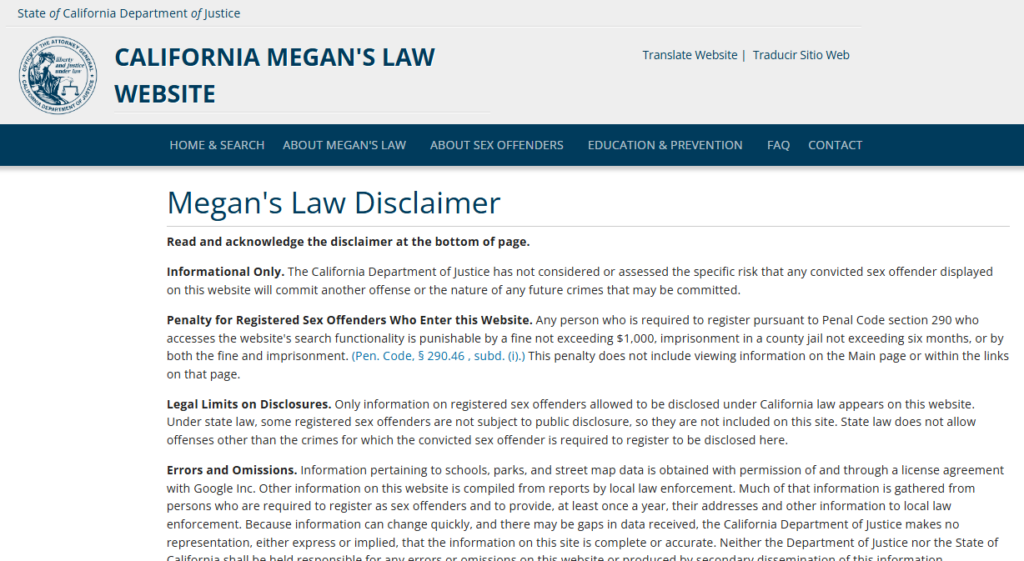
- Click on “I Agree” on the disclaimer page to proceed.
- On the search page, choose one of the following search methods:
- Name Search: Enter the offender’s first and last name in the “First Name” and “Last Name” fields. Click “Search.”
- Address Search: Type the street address in the “Address” field. Select the city from the dropdown menu. Click “Search.”
- Zip Code Search: Enter a 5-digit zip code in the “Zip Code” field. Click “Search.”
- School or Park Search: Select “School” or “Park” from the dropdown, then enter the name. Click “Search.”
- Review the results, which include the offender’s name, photo, address (if public), offense type, and registration status.
The Search Results
- The system displays up to 100 results per search.
- Each result includes:
- Full name and known aliases
- Current photograph
- Home address or general location (zip code level for non-public offenders)
- Offense description and conviction date
- Registration tier (1, 2, or 3)
- Compliance status (e.g., “Verified,” “Non-Compliant”)
- If no results appear, it means no registered offenders match the search criteria in that area.
- Results are not a complete list of all sex offenders—only those required to be publicly listed.
Limitations and Accuracy
- The database does not include offenders who are incarcerated, deported, or excluded from public disclosure.
- Address information may be delayed by up to 24 hours due to processing times.
- Homeless offenders are listed by last known zip code, not a physical address.
- Users should verify information with local law enforcement if accuracy is critical.
- The tool is not intended for employment, housing, or tenant screening without legal compliance.
California Sex Offender Registry Structure and Management
The California Sex Offender Registry is managed by the California Department of Justice (DOJ) through its Sex Offender Tracking Program. This centralized system collects, verifies, and disseminates offender data to law enforcement agencies and the public. The registry operates under strict legal guidelines to balance public safety with individual rights. It is updated daily with new registrations, address changes, and compliance updates. The DOJ works with local police departments, courts, and parole officers to ensure accurate and timely data entry. The system is designed to be transparent, accountable, and accessible while protecting the privacy of certain offenders based on statutory exemptions.
Tiered Classification System
- Tier 1 (Low Risk): Offenders convicted of less severe crimes, such as first-time indecent exposure or non-forcible acts with adults. Registration is required for 15 years.
- Tier 2 (Moderate Risk): Includes repeat offenders, crimes involving minors aged 14–17, or non-violent sexual assaults. Registration is required for 25 years.
- Tier 3 (High Risk): Applies to violent sexual offenses, crimes against children under 14, or sexually violent predators. Lifetime registration required.
- Tier assignments are made by the court at sentencing or by the DOJ based on risk assessment tools.
- Offenders can appeal their tier classification through a formal review process.
Data Verification and Compliance
- All registrants must appear in person at a law enforcement agency to verify their information.
- Verification includes confirming address, employment, vehicle information, and internet identifiers (e.g., email, social media).
- Failure to verify on time results in a misdemeanor charge and possible arrest.
- The DOJ conducts random audits to ensure data accuracy and compliance.
- Local police departments are responsible for conducting home visits for high-risk offenders.
Integration with National Databases
- California shares offender data with the FBI’s National Sex Offender Public Website (NSOPW).
- Offenders who move to another state must register in that state within five days.
- The Interstate Compact for Adult Offender Supervision (ICAOS) coordinates supervision across state lines.
- California participates in the National Crime Information Center (NCIC) to flag non-compliant offenders.
- International travel by registered offenders requires advance notification to law enforcement.
Legal Rights and Restrictions for Registered Sex Offenders
Registered sex offenders in California face significant legal restrictions that affect where they can live, work, and travel. These restrictions are designed to reduce recidivism and protect vulnerable populations, particularly children. However, they also raise constitutional questions about privacy, due process, and rehabilitation. The state enforces these rules through criminal penalties, civil commitments, and community supervision. Offenders must navigate a complex web of laws that vary by offense type, tier level, and local jurisdiction. Violations can result in additional criminal charges, extended registration periods, or reincarceration.
Residency Restrictions
- Offenders cannot live within 2,000 feet of a school, park, daycare, or playground.
- These restrictions apply to both owned and rented residences.
- Local cities and counties may impose stricter limits (e.g., 3,000 feet in Los Angeles).
- Homeless offenders must report their location every 30 days and are subject to curfews in some areas.
- Exceptions may be granted for family caregivers or medical necessity, but require court approval.
Employment and Volunteer Restrictions
- Offenders cannot work in jobs that involve regular contact with children, such as teaching, coaching, or childcare.
- They are prohibited from volunteering in schools, youth organizations, or religious groups with minors.
- Employers and volunteer coordinators must be notified of the offender’s status.
- Failure to disclose registration status to an employer is a misdemeanor.
- Some professions, like healthcare or transportation, may impose additional licensing restrictions.
Travel and Internet Use Restrictions
- Offenders must notify law enforcement before traveling outside California for more than 14 days.
- International travel requires approval from the U.S. Department of State and may be denied.
- Use of social media, email, or online gaming platforms is restricted for Tier 2 and Tier 3 offenders.
- Offenders must register all internet identifiers (usernames, emails) with the DOJ.
- Law enforcement may monitor online activity for compliance with restrictions.
Public Notification and Community Safety Measures
California law requires public notification when high-risk sex offenders move into a community. This process, known as community notification, is managed by the California Department of Justice and local law enforcement. The goal is to inform residents so they can take precautions to protect themselves and their families. Notification methods include mailers, public meetings, and online alerts. The level of disclosure depends on the offender’s tier and risk level. Tier 3 offenders and sexually violent predators receive the highest level of public notice. These measures are not intended to incite fear or harassment but to promote informed community decision-making.
Levels of Community Notification
- Level 1 (Limited): Notification to law enforcement and nearby schools. Used for low-risk offenders.
- Level 2 (Moderate): Notification to schools, daycare centers, and community organizations. Used for Tier 2 offenders.
- Level 3 (Broad): Public meetings, mailers to residents, and media announcements. Used for Tier 3 and SVPs.
- Notification decisions are made by a multidisciplinary team including police, probation, and mental health professionals.
- Residents can request notification if a high-risk offender moves into their neighborhood.
School and Park Zone Restrictions
- Offenders are prohibited from entering school grounds during school hours without written permission.
- Parks with playgrounds or youth facilities are off-limits unless the offender is a parent or guardian of a child present.
- Violating these zones is a misdemeanor punishable by up to one year in jail.
- Signs are posted at restricted areas to warn offenders of the legal boundaries.
- Local law enforcement conducts regular patrols near schools and parks to enforce compliance.
GPS Monitoring and Electronic Surveillance
- Tier 3 offenders and SVPs are required to wear GPS ankle monitors for life.
- Devices track location in real time and alert authorities if the offender enters a restricted zone.
- Tampering with the device is a felony offense.
- Data from GPS units is used in criminal investigations and parole hearings.
- Offenders must pay a monthly fee for monitoring, unless indigent.
Removal from the Registry and Rehabilitation Options
California allows certain sex offenders to petition for removal from the registry after completing their sentence and maintaining a clean record. This process is governed by Penal Code sections 290.45 and 290.46. Not all offenders are eligible—only those classified as Tier 1 or low-risk Tier 2 may apply. The petition must be filed in the county where the offender was convicted. A judge reviews the case, considers the victim’s input, and evaluates the offender’s rehabilitation. Successful removal ends registration requirements and restores certain civil rights. However, the conviction remains on the criminal record unless expunged separately.
Eligibility for Registry Removal
- Must have completed all sentencing terms, including probation and parole.
- Must have no new criminal convictions for at least 10 years (5 years for Tier 1).
- Must not be classified as a sexually violent predator (SVP).
- Must not have committed an offense against a child under 14.
- Must have complied with all registration requirements during the waiting period.
The Petition Process
- File a petition with the superior court in the county of conviction.
- Pay a filing fee (waivers available for indigent applicants).
- Submit evidence of rehabilitation, such as therapy records, employment history, and character references.
- Notify the district attorney and victim (if applicable).
- Attend a court hearing where the judge evaluates the request.
- If granted, the DOJ is notified to remove the offender from the public registry.
Treatment and Rehabilitation Programs
- California offers cognitive-behavioral therapy programs for sex offenders in prison and on parole.
- Programs focus on accountability, victim empathy, and relapse prevention.
- Participation is mandatory for parolees and can reduce recidivism by up to 30%.
- Community-based treatment is available through licensed providers.
- Treatment success may support a petition for registry removal.
| Agency | California Department of Justice |
| Address | P.O. Box 903427, Sacramento, CA 94203-4270 |
| Phone | (916) 210-7800 |
| Hours | Monday–Friday, 8:00 AM – 5:00 PM (Pacific Time) |
| Website | https://oag.ca.gov |
(FAQs) About California Sex Offenders
Sex offender registration laws in California are strict and highly structured, designed to support public safety and informed awareness. The following FAQs explain key aspects of the California sex offender registry, including search tools, legal consequences, data accuracy, and removal options. This section helps users better understand how the system works and what information is publicly accessible under California law.
Can I search for sex offenders by school name in California?
Yes, you can search for registered sex offenders near a specific school using the California Megan’s Law website. Go to https://www.meganslaw.ca.gov/Disclaimer, agree to the disclaimer, and select “School” from the search dropdown menu. Enter the full name of the school in the field provided. The system will return a list of all registered sex offenders whose addresses fall within a 1-mile radius of the school. Results include the offender’s name, photo, address, offense type, and tier level. This feature helps parents and staff assess potential risks near educational facilities. Note that the search only shows offenders required to be publicly listed—about 75% of registrants. The data is updated daily, but address changes may take up to 24 hours to appear. Always verify critical information with local law enforcement.
What happens if a sex offender fails to register in California?
Failure to register as a sex offender in California is a criminal offense. First-time violations are typically charged as misdemeanors, punishable by up to one year in county jail and a $1,000 fine. Repeat offenses or failures to update information (such as a new address) can be charged as felonies, carrying up to three years in state prison. Offenders must register within five days of release from custody or moving to a new location. Homeless offenders must verify their status every 30 days. If an offender fails to comply, law enforcement can issue a warrant for their arrest. The California Department of Justice flags non-compliant individuals in its database, and local police may conduct home visits. Non-compliance also extends the registration period and may result in the denial of removal petitions. Employers and volunteer organizations must be notified of registration status, and failure to disclose is a separate misdemeanor.
Are juvenile sex offenders listed on the California registry?
Juvenile sex offenders may be required to register in California, but their inclusion on the public website depends on the offense and court decision. Minors convicted of serious sexual crimes, such as rape or lewd acts with a child under 14, can be ordered to register. However, juvenile records are generally sealed, and public disclosure is rare. In most cases, juvenile offenders are not listed on the public Megan’s Law website unless a judge determines public safety requires it. Even then, their information is often limited to the zip code level. Juveniles must still register with law enforcement and comply with reporting requirements. Upon turning 18, they may petition to be removed from the registry if they meet eligibility criteria. The goal is to balance rehabilitation with public protection, recognizing that juveniles have a higher capacity for reform than adults.
How accurate is the California sex offender database?
The California sex offender database is highly accurate but not infallible. The California Department of Justice updates the system daily with data from courts, prisons, and local law enforcement. Over 63,000 offenders are registered, with 33,500 having listed home addresses and 30,500 tracked by zip code or city. However, limitations exist: about 25% of registrants are excluded from public view due to offense type or court orders. Address changes may take up to 24 hours to process. Homeless offenders are listed by last known zip code, not a physical address. The database does not include incarcerated, deported, or federally supervised offenders. Users should treat the information as a starting point, not a complete risk assessment. For critical decisions, contact local police or the DOJ directly. Misuse of the data for harassment or discrimination is illegal and punishable by law.
Can a sex offender be removed from the California registry?
Yes, certain sex offenders can be removed from the California registry through a court petition. Eligibility depends on the offense tier and compliance history. Tier 1 offenders may petition after 15 years, Tier 2 after 25 years, and Tier 3 offenders are generally not eligible unless exceptional circumstances exist. The offender must have completed all sentencing terms, including probation and parole, and have no new convictions for at least 5–10 years. The petition is filed in the county of conviction, and the court reviews evidence of rehabilitation, victim impact, and public safety. If granted, the California Department of Justice removes the offender from the public website, though law enforcement retains the record. Sexually violent predators and offenders against children under 14 are typically ineligible. The process can take several months and requires legal representation. Success rates vary, but rehabilitation and clean records improve chances.